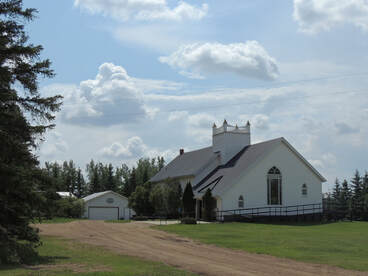
Sunday Summer Service Time 10:30am

25439 TWP Rd. 510 RR3
South Edmonton, AB T6H 4N7
(780)955-7774
rabbithillchurch@aol.com

Thursday, August 7, 2008

Grieving with Hope

It is never easy to lose someone you love. Death is a very painful reality that none of us can avoid dealing with in this life. It can cause a great deal of pain, anger and doubt to enter into our lives. Yet as those who have come to faith in Christ, we are given the ability to deal with it in a very unique way. Because of the resurrection of Jesus from the dead, we are given a sure and certain hope that death is not the end.

Blessed be the God and Father of our Lord Jesus Christ! According to his great mercy, he has caused us to be born again to a living hope through the resurrection of Jesus Christ from the dead. -1 Peter 1:3 (ESV)

This does not mean however that we can not or should not grieve the loss of a loved one. As American author Bruce Barton once said, "Too many Christians feel that grief is wrong, that we're supposed to rejoice when a loved one goes to be with the Lord. While we can rejoice in their going home, we can also grieve our loss." Death is very painful and it rightly deserves our grief and anger, but as those who have been saved by grace, we have the ability of grieving with hope.

Christian music artist Steven Curtis Chapman and his wife recently lost their youngest daughter in a tragic family accident. In the following interview the couple shares their story and their pain in a very open and honest way. Yet they want to make it very clear that as incredibly painful as it has been, they still have the hope of one day being reunited with their daughter.


video

We do not want you to be uninformed, brothers, about those who are asleep, that you may not grieve as others do who have no hope. - 1 Thes. 4:13 (ESV)

_______________________________

Thursday, June 26, 2008

Creative Thinking

I had the privilege of attending a lecture on Evolutionary Creation (aka Theistic Evolution) by Dr. Denis Lamoureux at St. Joseph's College (part of the Univ. of Alberta) yesterday. It was by all accounts an excellent presentation on the subject and I would recommend it to anyone interested in this issue. Even though I did not agree with much of what was being taught, it certainly helped me to understand this theory that seems to be gaining popularity among evangelicals. For those of you who may not know, evolutionary creation basically teaches that God created life on earth indirectly through preordained natural processes. That is to say that God used evolution as a means of creating you and I.

Now there are to be sure a lot of theological questions/concerns that I have with this theory. For example, what about Adam and the fall? If man is the result of evolution, was there in fact one historical man named Adam? Why is this important? Biologist David H. Lane explains in his essay "Theological Problems with Theistic Evolution".

If Adam was not a historical figure and the Fall is not historical, then the typology of Christ as the last Adam (Rom 5:12–14; 1 Cor 15:22, 45–49) becomes meaningless, as do the doctrines of redemption, atonement, and justification. Furthermore Paul specifically related the historicity of Adam to the historicity of Christ’s resurrection, thereby laying a basis for the believer’s hope in the resurrection of the dead (1 Cor 15:12–23). The linchpin of the gospel (Christ’s resurrection) is anchored in the historicity of Adam and the Fall.

Again, there are many such theological concerns that are related to the theory of Evolutionary Creation. Still, the basic question remains, is the theory of evolution compatible with scripture in the first place? I personally do not believe it is. Instead I believe that Genesis clearly teaches that "The work of creation is," as the Westminster Shorter Catechism says, "
God's making all things of nothing, by the word of his power, in the space of six days, and all very good."

How then do I account for the apparent age of the earth? Perhaps, just as God created Adam as a grown (let's say 20 year old) man in one day, God also created a "full grown" (10 billion year old) earth in six. If you are interested in finding out more about what is called the "Mature Earth" view you can find it on p.113 of Vern Poythress' book Redeeming Science which you can read for free here.

In the end, as with any other issue, we need to remain in open dialogue with one another. This of course does not mean that we can not or should not have personal convictions or hold to a certain position with passion as Dr. Lamoureux thankfully does, otherwise it would have been a boring lecture. It simply means that as we do so, not only do we need to speak graciously, but we also need to listen to others sides of the discussion in order to interact with them and be informed. This is why I went to the lecture in the first place, and this is why I want to share the following video clip with you, as food for thought.

video

By faith we understand that the universe was created by the word of God, so that what is seen was not made out of things that are visible. - Hebrews 11:3 (ESV)

________________________________

Thursday, June 12, 2008

Cause for Concern or Not

The National Post ran a story today about a youth pastor from Red Deer who was recently brought before the Alberta Human Rights Commission over his written stance on homosexuality. Now to be sure, this is an issue that the church has all too often handled poorly, frequently without any grace and humility, forgetting that we are called to speak the truth in love. Yet, the point is, we are clearly called to speak the truth, even when it is counter cultural. The question is, does this story represent just another blip on the proverbial radar or is it a sign of things to come?

The judgment of the Alberta Human Rights and Citizenship Commission (AHRCC) against the Reverend Stephen Boissoin, a Protestant youth pastor, is a direct violation of his religious liberty. Whatever his "guilt" --and who is not guilty before the human rights commission? -- the judgment requires him to write an apology abjuring his views on homosexuality, and prohibits him and the Concerned Christian Coalition from making "disparaging" remarks about homosexuals.

It is not specified what the AHRCC might consider "disparaging," but simply reading in public -- as in a sermon -- the Biblical admonitions against homosexual acts is not precluded. Indeed, the scope of the AHRCC order is so wide that it effectively says that Rev. Boissoin may not speak publicly on homosexuality ever again, unless he changes his opinion.

Given that the "offence" was a letter to the editor published in the Red Deer Advocate, the judgment by implication would apply the same restrictions to the newspaper itself. The offence was "causing to be published" the letter, which "was likely to expose homosexuals to contempt or hatred because of their sexual orientation." In order for something to be published in a newspaper, both a writer and an editor/publisher are required. Had the complainant in this case named the Red Deer Advocate in his charge, there is every logical reason to expect that the AHRCC would have slapped a perpetual ban on the newspaper publishing any "disparaging" stories on homosexuality.

Rev. Boissoin is not the only Alberta clergyman hauled before the AHRCC. In 2005, Frederick Henry, the Roman Catholic Bishop of Calgary, was brought before the commission for writing a pastoral letter against same-sex marriage to his own flock. Before the AHRCC had a chance to find him guilty, Bishop Henry clarified his remarks and the complaint was withdrawn. It is now clear that had it gone ahead, the AHRCC would have ordered the bishop of Calgary not to speak about same-sex marriage ever again.

To read the entire article click here.

Again, this is an issue that the church and its leaders must handle graciously, acknowledging that we are all sinners in need of God's mercy. Still, this story is somewhat concerning as we think about what the future may hold for the church in Canada. May we always be willing to stand up for the truth, yet may we always "do it with gentleness and respect, having a good conscience, so that, when you are slandered, those who revile your good behaviour in Christ may be put to shame." 1 Peter 3:16 (ESV)

___________________________________________

Tuesday, June 3, 2008

Some Discernment Required

Don't you hate it when you go through all that effort of choosing the perfect gift for your children only to discover, when they open it, those three dreaded words: some assembly required. Just when you thought that your work was over. Instead, you now realize that you will be spending the next hour carefully following the instruction as your kids repeatedly ask you, is it ready yet, is it ready yet?

Similarly, as Christians, we should never think that our work is over. That since Christ has purchased this great gift for us and paid for our sins, we can now simply coast through life reading, watching and listening to whatever we want. As Paul would say, certainly not. Instead, as we live out our faith from day to day, we should always heed the label: some discernment required. This means that we should be asking questions like is this good for me? Is this biblical? Is this helpful or harmful to my faith?

Discernment is not a matter of simply telling the difference between right and wrong; rather it is telling the difference between right and almost right.

C.H. Spurgeon


We all realize that there are lots of things in this world that are spiritually harmful and confusing that we need to try our best to avoid. But what compounds this problem of discernment is that some of it is found and promoted right at our local Christian book stores. Case in point "The Shack", the newest "life changing" best seller that has sold millions and reached the top ten in total sales, of all books, not just Christian, on Amazon.com. Even though it is a work of fiction, it conveys some very confusing theology to say the least. In fact, some have gone so far as to labeled it as heresy. As such, I would highly recommend that you access one, if not all of the following three resources to get an idea of what it's about and why there is so much concern about it's success.

First, you can read an excellent review of the book by Tim Challies at his blog.

Second, you can listen to Dr. Albert Mohler's radio program on "The Shack" here.

Or third, you can simply click on the video below to watch pastor Mark Driscoll share his concerns about it.


Jesus Christ is the same yesterday and today and forever. Do not be led away by diverse and strange teachings, for it is good for the heart to be strengthened by grace, not by foods, which have not benefited those devoted to them.
Hebrews 13:8-9 (ESV)
____________________________________________

Tuesday, May 27, 2008

A Just Cause

One of the things we continually need to remember is that our faith is about more than just having our sins forgiven and living right. As Christians, our faith in Christ should not be compartmentalized. Instead, it should flow into or affect every area of our lives, when we are at home, at work, at school, when we're watching the news or thinking about social issues such as abortion, homelessness and prostitution.

This is why agencies such as International Justice Mission are so important, because they help shine the light on
global issues such as victims of violence, sexual exploitation, slavery and oppression. But don't let their name fool you into thinking that these are things we as Canadians do not deal with. Rather these are very much issues that hit close to home as this article from Canadian Christianity reveals. Here is part of what it says.

When Vancouverite Donald Bakker pleaded guilty to 10 counts of sexual assault - seven of them under Canada's hitherto untested sex tourism law - much of the credit was due to a heroic group of Christian undercover investigators, who secretly tracked down his under aged victims and videotaped the Cambodian brothels where Bakker committed his assaults. But British Columbian men don't have to fly to Indochina for sex. A huge criminal enterprise has enveloped the globe, designed to deliver women and children to the customer's door. Most are illegal immigrants duped with the promise of jobs as restaurant workers, janitors or maids. The RCMP estimates 600 women and children are brought into Canada yearly, mostly to slake the sexual appetites of Canadian men; while 1,500 more are brought through Canada to the United States.


This is, of course, only the tip of the iceberg, the world we live in is filled with similar stories of injustice and abuse. The question is, how does one get involved? What is our church doing about it? Where do we, as individuals, start in this fight for justice? Well, to begin with, we can start by becoming informed. This Saturday night (May 31, 2008 @ 7:30pm) McKernan Baptist church is hosting an evening with Canadian IJM president Jamie McIntosh and Canadian recording artist Caroline Arends, to get tickets or to find out more about it click here.

Justice is close to the heart of God. The work of IJM gives the hope of justice to those who have been wrongfully imprisoned and detained. I applaud their work on behalf of the innocent.
- Charles W. Colson, Chairman of the Board, Prison Fellowship Ministries
Give justice to the weak and the fatherless; maintain the right of the afflicted and the destitute. Rescue the weak and the needy; deliver them from the hand of the wicked.
Psalm 82:3-4 (ESV)
_______________________________________________

Wednesday, May 21, 2008

What is Reformed?

There are, as I'm sure you know, many different types of churches and, for that matter, individual Christians throughout the world today. For example, there are those that are Catholic and Protestant, liberal or conservative, traditional or contemporary, charismatic, emergent and, of course, the much maligned fundamentalists, who seem to be less about the "fun" and more about the "mental", just kidding. In any case, each of these are defined, for the most part, by their theology or system of beliefs.

What then does it mean when a church or an individual Christian, like myself, is described as being "reformed". Reformed from what? If you are interested in reading a clear yet concise summary of reformed theology, I would direct your attention to either B.B. Warfield's classic essay here or for something much more recent, to Tim Challies web page here. If watching a short two minute video clip on the subject is more your thing, then here is an excellent answer to this question of what it means to be reformed from Dr. Ligon Duncan of Reformed Theological Seminary.


video

Ephesians 2:4-5 (ESV)
God, being rich in mercy, because of the great love with which he loved us, even when we were dead in our trespasses, made us alive together with Christ, by grace you have been saved.
_______________________________________________

Wednesday, May 14, 2008

Expelling Worldliness with a New Affection

This past Sunday we looked at John 17:6-19 and the challenge of being in the world but not of the world. This, of course, begins by having the natural love that we have for the world replaced with a new love that is centered on God. Sinclair Ferguson has written an excellent article about this that I want to share with you.

Thomas Chalmers (1780-1847) was one of the most remarkable men of his time—a mathematician, evangelical theologian, economist, ecclesiastical, political, and social reformer all in one. His most famous sermon was published under the unlikely title: “The Expulsive Power of a New Affection.” In it he expounded an insight of permanent importance for Christian living: you cannot destroy love for the world merely by showing its emptiness. Even if we could do so, that would lead only to despair. The first world–centered love of our hearts can be expelled only by a new love and affection—for God and from God. The love of the world and the love of the Father cannot dwell together in the same heart. But the love of the world can be driven out only by the love of the Father. Hence Chalmers’ sermon title.

True Christian living, holy and right living, requires a new affection for the Father as its dynamic. Such new affection is part of what William Cowper called “the blessedness I knew when first I saw the Lord”—a love for the holy that seems to deal our carnal affections a deadly blow at the beginning of the Christian life. Soon, however, we discover that for all that we have died to sin in Christ, sin has by no means died in us. Sometimes its continued influence surprises us, even appears to overwhelm us in one or other of its manifestations. We discover that our “new affections” for spiritual things must be renewed constantly throughout the whole of our pilgrimage. If we lose the first love we will find ourselves in serious spiritual peril.

Sometimes we make the mistake of substituting other things for it. Favorites here are activity and learning. We become active in the service of God ecclesiastically (we gain the positions once held by those we admired and we measure our spiritual growth in terms of position achieved); we become active evangelistically and in the process measure spiritual strength in terms of increasing influence; or we become active socially, in moral and political campaigning, and measure growth in terms of involvement. Alternatively, we recognize the intellectual fascination and challenge of the gospel and devote ourselves to understanding it, perhaps for its own sake, perhaps to communicate it to others. We measure our spiritual vitality in terms of understanding, or in terms of the influence it gives us over others. But no position, influence, or evolvement can expel love for the world from our hearts. Indeed, they may be expressions of that very love.

Others of us make the mistake of substituting the rules of piety for loving affection for the Father: “Do not handle! Do not taste! Do not touch!” Such disciplines have an air of sanctity about them, but in fact they have no power to restrain the love of the world. The root of the matter is not on my table, or in my neighborhood, but in my heart. Worldliness has still not been expelled.

It is all too possible, in these different ways, to have the form of genuine godliness (how subtle our hearts are!) without its power. Love for the world will not have been expunged, but merely diverted. Only a new love is adequate to expel the old one. Only love for Christ, with all that it implies, can squeeze out the love of this world. Only those who long for Christ’s appearing will be delivered from Demas-like desertion caused by being in love with this world.

How can we recover the new affection for Christ and his kingdom that so powerfully impacted our life-long worldliness, and in which we crucified the flesh with its lusts?

What was it that created that first love in any case? Do you remember? It was our discovery of Christ’s grace in the realization of our own sin. We are not naturally capable of loving God for himself, indeed we hate him. But in discovering this about ourselves, and in learning of the Lord’s supernatural love for us, love for the Father was born. Forgiven much, we loved much. We rejoiced in the hope of glory, in suffering, even in God himself. This new affection seemed first to overtake our worldliness, then to master it. Spiritual realities—Christ, grace, Scripture, prayer, fellowship, service, living for the glory of God—filled our vision and seemed so large, so desirable that other things by comparison seemed to shrink in size and become bland to the taste.

The way in which we maintain “the expulsive power of a new affection” is the same as the way we first discovered it. Only when grace is still “amazing” to us does it retain its power in us. Only as we retain a sense of our own profound sinfulness can we retain a sense of the graciousness of grace.

Many of us share Cowper’s sad questions: “Where is the blessedness I knew when first I saw the Lord? Where is the soul-refreshing view of Jesus and his word?” Let us remember the height from which we have fallen, repent and return to those first works. It would be sad if the deepest analysis of our Christianity was that it lacked a sense of sin and of grace. That would suggest that we knew little if the expulsive power of a new affection. But there is no right living that last without it.

Do not love the world or the things in the world. If anyone loves the world, the love of the Father is not in him. - 1 John 2:15 (ESV)
_______________________________________________